product
Attached Paper Straws for Carton Packing Lines
Attached paper straws are supplied as connected rows of individually wrapped units for carton-side application. A useful specification aligns the straw, wrapper, row pitch, feeding direction and carton attachment zone before line validation.
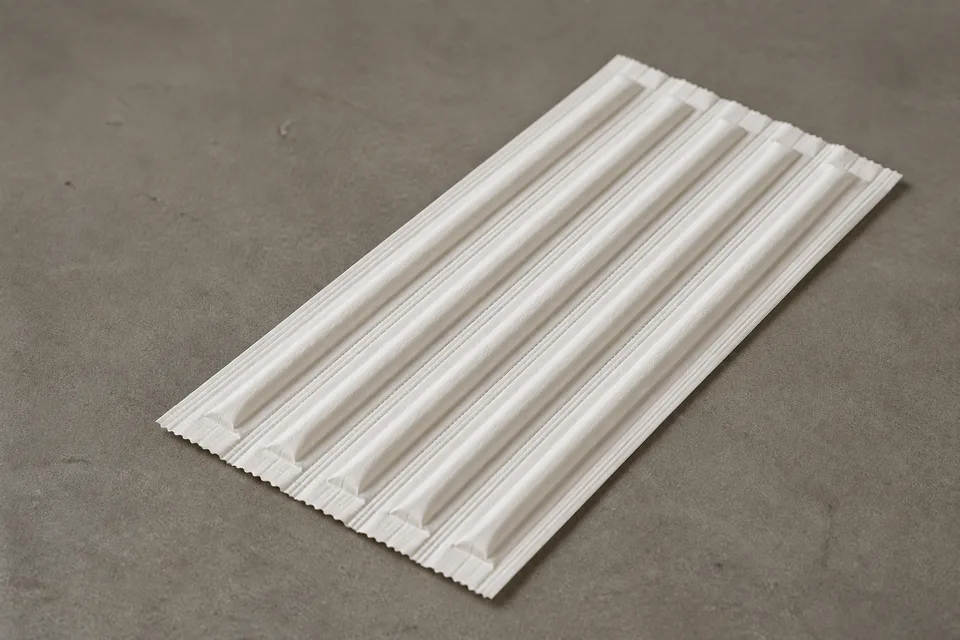
When Is an Attached Format the Right Starting Point?
Review an attached format when the packing process requires connected rows that can be oriented, fed and separated for carton-side placement. The decision depends on the applicator path and carton layout, not only on straw diameter and length.
Which Details Define the Connected Row?
| Specification input | What it controls | How it is confirmed |
|---|---|---|
| Straw diameter | Piercing behavior, drinking feel and wrapper fit | Product target and sample review |
| Straw length | Reach from the carton opening during use | Carton dimensions and use position |
| Piercing tip | Interaction with the applicable opening film | Carton and sample check |
| Row pitch | Spacing between repeated wrapped units | Applicator requirement |
| Feeding direction | Orientation of the row entering the handling system | Line layout or applicator information |
| Wrapper width | Space around the straw and handling interface | Straw size, seal and applicator requirement |
| Seal area | Integrity and separation behavior of the wrapper | Wrapper construction and sample check |
| Attachment zone | Position available on the carton side panel | Carton drawing |
| Print registration | Artwork position relative to each wrapped unit | Approved artwork and repeat specification |
What Should Be Reviewed before a Line Trial?
Row presentation
Confirm the row orientation, reference edge and feeding direction so the connected units arrive in the expected position.
Wrapper handling
Review wrapper width, seal area, connection between units and separation behavior under the applicable handling conditions.
Carton placement
Confirm that the wrapped straw fits the available side-panel area without conflicting with folds, graphics, seams or the opening position.
Piercing and use
Check the applicable tip and straw position with the selected carton opening, beverage and intended drinking reach.
What Should an Attached-Straw Sample Demonstrate?
- The selected dimensions fit the carton drawing.
- The row pitch and feeding direction match the review requirement.
- The wrapper and connection are suitable for the intended handling test.
- The wrapped unit fits the selected attachment zone.
- The straw, tip and drinking length can be evaluated with the applicable carton and beverage.
- The approved sample can be recorded as the repeat-order reference.
What Information Makes the First Sample More Useful?
- Carton drawing or clear panel dimensions
- Straw and opening position
- Applicator model, layout or existing row sample if available
- Required row pitch and feeding direction if known
- Target straw diameter and length
- Wrapper material, width, print and seal requirement
- Beverage type and destination market
- Estimated annual volume and packing requirement
Common Reference Sizes for Attached Straight Straws
Connected-strip projects often begin with a straight straw size already used on the carton line. Broad published I-shaped straw families cover approximately 3–7.5 mm outside diameter and 70–260 mm overall length. Representative wrapped-strip configurations include 4.2 mm outside diameter with 155 mm or 185 mm straw length. These figures are dimensional starting points only; the paper tube and connected wrapper must be rebuilt around the target carton and applicator.
| Parameter | Published Market Reference | Confirmation for the Paper Version |
|---|---|---|
| Outside diameter | 3–7.5 mm broad I-shaped reference; 4.2 mm representative connected-strip example | Confirm required OD, paper-wall construction and dimensional tolerance |
| Inside diameter | 3.8 mm representative plastic reference with 4.2 mm OD | Do not assume the same wall relationship in paper; confirm flow and tube construction by sample |
| Straw length | 70–260 mm broad reference; 155 mm and 185 mm representative connected-strip examples | Confirm required user reach, carton height and attachment-panel space |
| Row pitch | Approximately 15 mm per wrapped unit in representative strip examples | Confirm applicator feed, indexing, cutting and registration requirements |
| Published wrapper-film width | 170 mm or 200 mm representative examples | Recalculate for straw length, wrapper material, sealing area and print layout |
| Diagonal tip angle | Approximately 45–50° representative reference | Confirm against straw-hole construction and piercing requirements |
Published wrapper-film values describe representative plastic-strip systems. A paper wrapper or a different film construction may require different dimensions, seals and machine settings.
Reference dimensions support RFQ preparation and sample development. They are not a universal stock-size list or a guarantee of direct replacement. Final dimensions, tolerances and line behavior require project-specific drawing and sample validation.
Questions About Attached Paper Straws
Can an attached paper straw be confirmed from dimensions alone?
Dimensions are the starting point, but connected-row projects also require row pitch, feeding direction, wrapper and attachment-zone review. Final line suitability should be confirmed with the applicable sample and handling conditions.
Can the wrapper be printed?
Printing can be reviewed as part of the wrapper specification. Artwork position, print coverage, wrapper width, seal area and repeat registration must be considered together.
What is the main risk in an attached format?
The main risk is treating the straw as an isolated item. A straw may have the correct diameter and length but still be unsuitable if the connected row, wrapper or feed orientation does not match the application process.
What should be approved for a repeat order?
Keep the approved product sample, dimensional specification, row orientation, wrapper artwork, packing requirement and agreed inspection points as the repeat-order reference.