
In This Guide
Feeling the pressure to increase production output on your beverage carton line? You're not alone. Many factory managers I talk to are constantly looking for ways to push their line faster. But when it comes to attached paper straws, cranking up the speed can lead to misaligned straws, poor adhesion, and costly line stoppages. The solution isn't just about finding the "fastest" machine; it's about understanding how carton conveyor speed affects your entire system to achieve flawless attached paper straw placement.
The carton conveyor speed directly dictates the time available for the applicator to place the straw and for the adhesive to form a strong bond. It is not an independent metric but the result of a balanced system. Pushing the speed too high compromises the precision and adhesion of attached paper straw placement, leading to quality failures. The optimal speed is one that maximizes throughput while maintaining a near-perfect successful placement rate for your specific carton, straw, and adhesive combination.
Now that you know speed is just one piece of a much larger puzzle, you're probably wondering what the other pieces are. Let's break down what really drives successful, high-speed production and how to get it right.
Why Is "Placements Per Minute" the Wrong Metric to Focus On?
When you're evaluating new equipment, it's easy to get fixated on the big, bold number: Placements Per Minute (PPM). A higher number seems better, right? It promises more output and higher efficiency. But in my experience, focusing only on PPM is one of the most common mistakes I see.
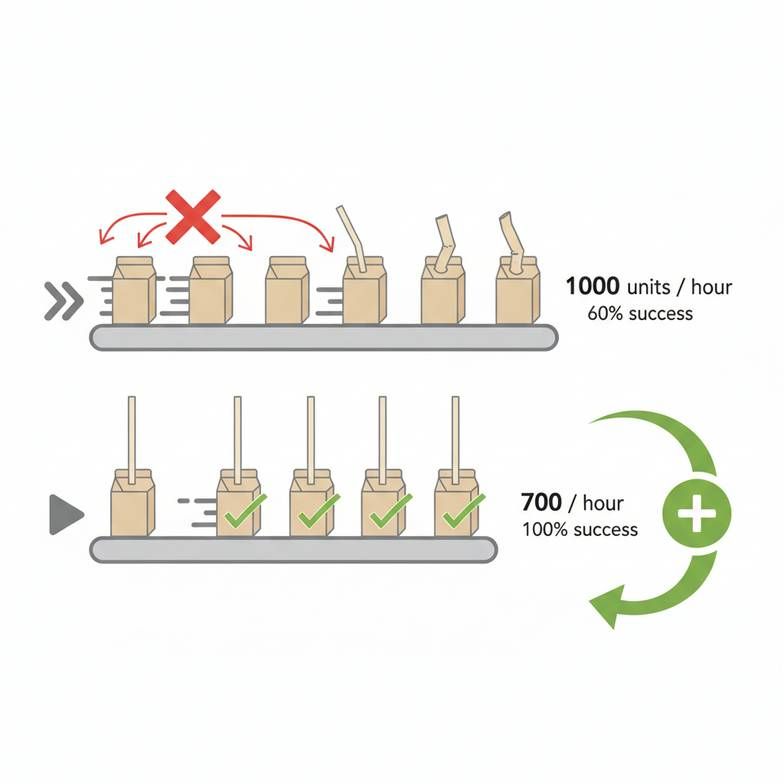
The raw PPM figure is often an ideal-case number that doesn't account for the small errors that add up to big problems. A slightly slower line with near-perfect placement is far more profitable than a "faster" line that constantly produces defects.
Dive Deeper into True Throughput
Let's think about this in practical terms. Your goal isn't just to run cartons through the line; it's to produce sellable, high-quality products. The real metric you should care about is the successful placement rate at a given speed.
Imagine two scenarios for a run of 1,000,000 cartons:
- Line A: Runs at a blistering 400 PPM but achieves only a 98% successful placement rate.
- Line B: Runs at a more conservative 350 PPM but hits a 99.9% successful placement rate.
Let's do the math.
| Metric | Line A (Faster Speed) | Line B (Optimized Speed) |
|---|---|---|
| Advertised Speed | 400 PPM | 350 PPM |
| Success Rate | 98% | 99.9% |
| Defective Units | 20,000 | 1,000 |
| Waste & Rework Cost | High | Low |
| Downtime from Jams | Frequent | Minimal |
| Effective Throughput | Lower than expected | Predictable and High |
Line A produces 20,000 defective units. That's 20,000 straws wasted, 20,000 cartons potentially ruined, and significant time spent on quality control, rework, or line stoppages to clear jams caused by loose straws. The machine might be capable of 400 PPM, but its effective, quality-assured output is much lower.
Line B, while seemingly "slower," produces only 1,000 defective units. The reduction in waste, material cost, and operator intervention makes it vastly more efficient and profitable in the real world. This is the difference between focusing on raw speed and optimizing for quality attached paper straw placement.
What Are the Key System Variables Affecting Attached Paper Straw Placement?
When a straw fails to attach correctly, it's easy to blame the most obvious moving part: the conveyor. You might think, "it's just moving too fast!" But the conveyor is only one actor in a five-part play. A failure in attached paper straw placement is almost always a system problem, not just a speed problem.
To truly diagnose and solve issues, you have to look at how all the components interact. Each one has a job to do in a very short window of time, and if one is out of sync, the whole process can fail.
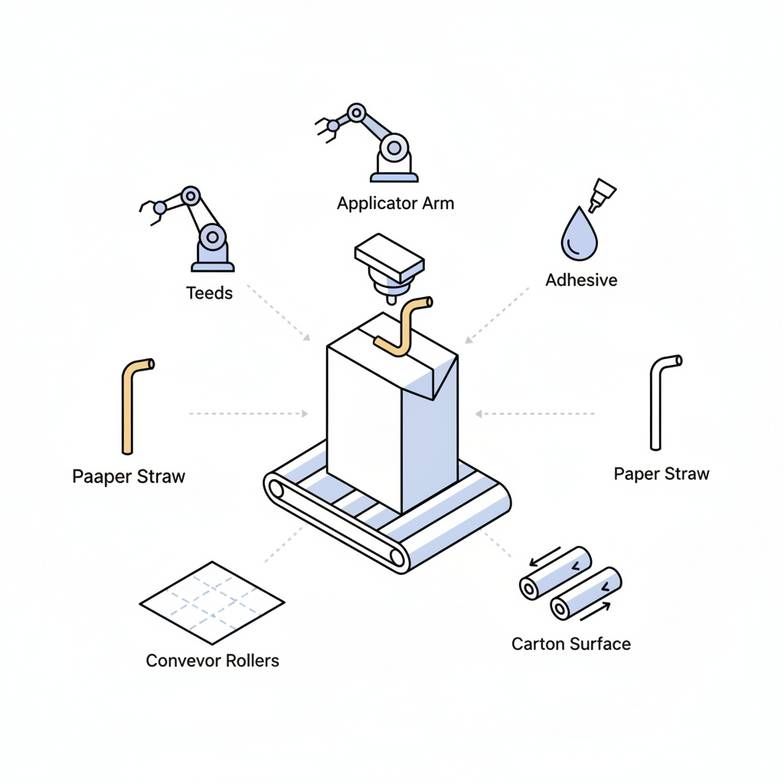
Dive Deeper into the Five Core Components
Let's break down the system. When we work with clients to set up a new production line, we don't just look at speed. We audit these five interconnected areas to ensure they work in harmony.
The Straw Applicator
This is the robotic arm or mechanism that picks up the straw and places it on the carton. Its precision is paramount. We look at factors like:
- Mechanical Wear: Are the grippers or vacuum heads worn? A worn head can't hold the straw securely, causing it to shift during placement.
- Calibration: Is the applicator perfectly calibrated to the X, Y, and Z axes of the carton's position on the conveyor? Even a millimeter of drift can cause misalignment.
- Timing: Is the applicator's cycle time perfectly synced with the conveyor speed and the adhesive application?
The Adhesive
The glue is the unsung hero. We often see issues here that are misdiagnosed as speed problems. Key adhesive properties include:
- Open Time: This is the window of time after the glue is applied during which it remains wet and sticky enough to form a bond. If the conveyor is too fast, the carton might move past the applicator before the straw is placed, exceeding the open time.
- Curing Time: This is how long it takes for the glue to set and achieve its full strength. If straws are handled or packed before the glue has cured, they can easily fall off.
- Viscosity: The thickness of the glue affects how it's applied and how it holds the straw. Too thin, and it might not provide enough grip; too thick, and it might not dispense properly at high speeds.
The Paper Straw Itself
Yes, the straw's properties matter. Not all paper straws are created equal, especially when it comes to high-speed automation. We check for:
- Consistency: Are the straws uniform in weight, diameter, and stiffness? A heavier-than-normal straw might droop or shift during placement.
- Surface and Shape: Is the straw's wrapping smooth? For U-shaped straws, is the bend consistent? Irregularities can cause issues with the applicator's grippers.
The Carton Surface
The straw doesn't stick to the carton; it sticks to the carton's surface. We analyze:
- Material: Is it a glossy, coated board or a more porous, matte finish? Different surfaces require different types of adhesive.
- Condensation: If you're filling cold beverages, condensation can form on the carton surface, preventing the adhesive from bonding correctly. This is a huge factor.
- Printing & Varnish: Are there inks or overprint varnishes in the placement area that could interfere with adhesion?
The Conveyor and Carton Handling
Finally, we get to the conveyor. The key here is not just speed, but stability. A carton that is vibrating, tilting, or shifting on the belt is impossible to place a straw on accurately, no matter how slow you go. Guide rails, belt tension, and smooth transitions are critical.
How Can You Determine the Optimal Speed for Your Production Line?
So, if there's no single "best" speed, how do you find the sweet spot for your specific setup? The answer is through a structured, data-driven testing process. Forget guesswork. You need to become a scientist on your factory floor.
The goal is to find the highest possible speed that does not compromise your quality standard. This is your Maximum Optimal Throughput, and it's a number you discover through validation, not from a machine's sales brochure.

Dive Deeper into the Validation Process
Instead of asking a supplier "How fast can it go?", you should be asking, "What's the process for validating the optimal speed for my cartons and straws?" Here is the step-by-step approach we use with our clients.
- Establish a Baseline: Start at a conservative speed where you know you can achieve near-perfect placement (e.g., 99.9% or better). This is your control. Run a significant number of cartons (e.g., 10,000) to get a statistically valid success rate.
- Define "Success": Be brutally honest about what constitutes a pass or fail. A "pass" should mean the straw is perfectly centered, fully adhered, and stays on through simulated downstream handling. A slightly crooked straw is a "fail."
- Incrementally Increase Speed: Increase the conveyor speed by a small amount (e.g., 5-10%). Run another large batch and meticulously measure the successful placement rate.
- Document Everything: Record the speed, success rate, and importantly, the types of failures you see.
- Is the straw misaligned horizontally? (Could be a timing or conveyor guide issue).
- Is it falling off? (Likely an adhesive or curing time issue).
- Is the applicator dropping straws? (Could be a mechanical or vacuum issue).
- Analyze Failure Points: As you increase the speed, you'll eventually see your success rate start to dip. The point at which it drops below your acceptable quality threshold (e.g., 99.9%) is your current limit. The way it fails tells you what to fix. For example, if straws start falling off, you might not need to slow down; you might need a faster-curing adhesive.
By following this process, you stop guessing and start engineering. Your optimal speed is the highest rate you can run while maintaining your quality target. This is the key to maximizing real-world throughput and profitability.
Frequently Asked Questions
What's a good successful placement rate for attached paper straws?
While every company has its own standards, we advise clients to aim for a successful placement rate of 99.9% or higher. Anything less can lead to significant waste and customer complaints over a large production run. The goal is to make defects an extremely rare event.
Can the wrong adhesive cause placement issues even at low speeds?
Absolutely. If the adhesive's "open time" is too short, it can start to dry before the straw is even placed. If its viscosity is wrong for the applicator nozzle or the carton surface, it won't apply correctly. Adhesive choice is critical and must be matched to your specific line speed and materials.
How do I test if my paper straws are suitable for high-speed application?
Work with your supplier. Request specifications on weight, stiffness, and dimensional consistency. A good supplier should be able to provide straws that are manufactured within tight tolerances for automated lines. The best test is to run a trial batch on your actual equipment to see how they perform.
Should I buy the fastest straw applicator machine available?
Not necessarily. The "fastest" machine is useless if it can't integrate with your existing line or handle your specific straws and cartons accurately. It's better to invest in a machine that demonstrates proven reliability and accuracy for a setup like yours, even if its top PPM number isn't the highest on the market.
Conclusion
When it comes to your beverage carton line, carton conveyor speed is a tempting but misleading metric. Chasing the highest possible PPM without considering the entire system is a recipe for waste, downtime, and quality control headaches. The true path to higher throughput lies in a holistic approach. By focusing on the successful placement rate and optimizing the interplay between your conveyor, applicator, adhesive, carton, and straw, you can find the optimal speed that maximizes efficiency without sacrificing quality. This system-level thinking is the key to reliable and profitable attached paper straw placement.
If you're looking to optimize your production line or source the right components that work together seamlessly, let's talk. Our experience with both finished straws and production machinery allows us to help you configure a solution that truly balances speed and quality. Request a carton format review today and let's build a more efficient line together.
Matched Formats for Beverage Cartons
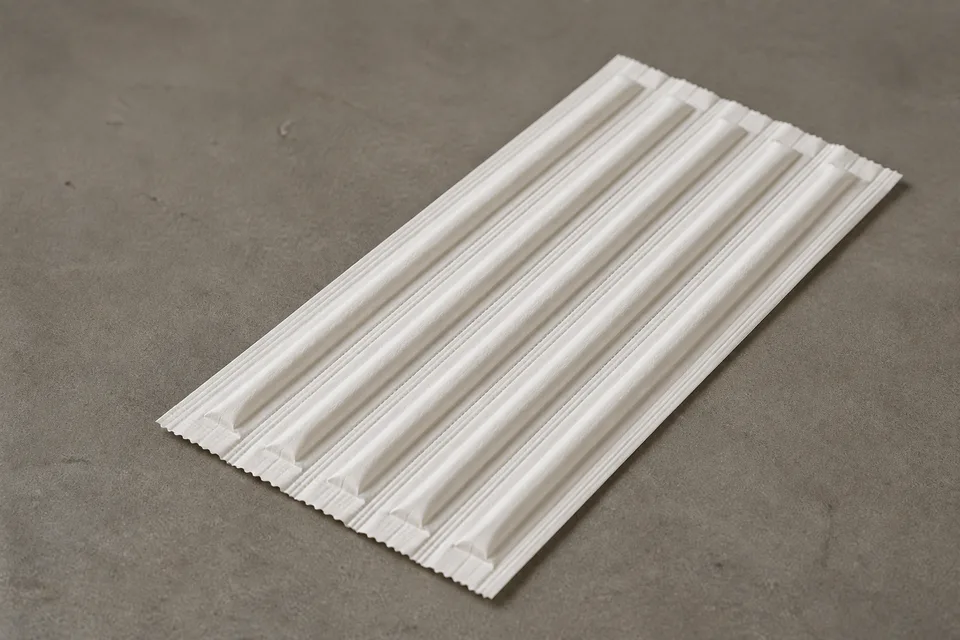
Attached Paper Straws
Connected continuous strip for high-speed automatic carton applicators.
View Product Specs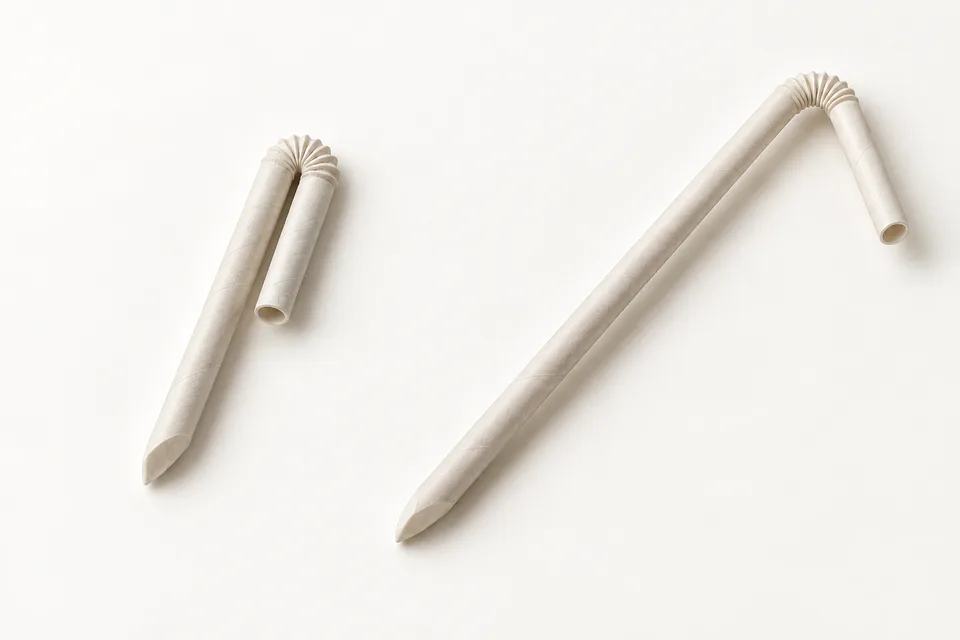
U-Shaped Paper Straws
Folded 180° format maximizing drinking reach on compact beverage cartons.
View Product Specs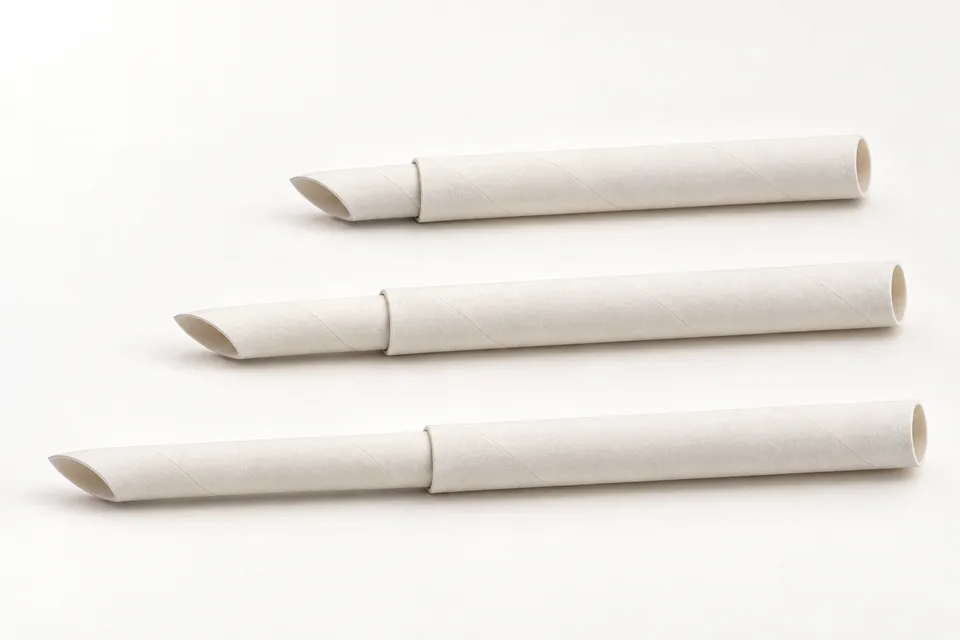
Telescopic Paper Straws
Two-section extendable design offering maximum reach from minimum packed length.
View Product Specs